Using Directories for SEO: Getting Listed, and Building Your Own
Two different tactics get called the same thing. Submitting to directories is a small one-off. Running one is a content asset that compounds, and it only works if the pages say something nobody else has.
Posted by
 Rouzbeh
Related reading
Giving a Support Chatbot Tools, Not Just Documents
A bot that answers from your docs is a weekend. A bot that can read and change a customer's own account is a different problem, and almost none of it is the AI part.
Answering Support When You Are the Whole Company
Support is the highest-quality research channel a small product has, and the fastest way to burn out if you treat it as an obligation. How to answer, what to automate, and how to say no.
The Pricing Page: What to Put On It, and What to Leave Off
Picking the number is one problem, presenting it is another. Plan names, the free tier decision, trials and card-up-front, annual billing, and the things founders add that quietly cost them customers.
"Directories for SEO" describes two tactics that have almost nothing in common. One is submitting your product to other people's directories, which is an afternoon of work and a handful of links. The other is running a directory yourself, which is a content asset that can outgrow the product it was meant to promote. Most advice blends them together, which is why founders try the first, see very little, and conclude directories do not work.
Table of contents
What a listing actually does
Briefly, because I have written about this at length in which launch directories are actually worth it. A listing gets you a page on someone else's domain describing your product in someone else's words. The link matters less than founders hope. The third-party description matters more than they expect, because it is one of the inputs an AI assistant uses when deciding what your product is, which I covered in generative engine optimization for indie founders.
Treat it as a one-off afternoon, not a channel. Submit to the ones with real traffic and real editorial standards, skip anything promising guaranteed rankings, and then stop. The returns fall off a cliff after the first handful, and the time is better spent on the second tactic.
The other move: running one yourself
A directory is one of the few content formats where the structure does the SEO work for you. One page per entry, one page per category, one page per combination that people actually search for. A hundred listings can legitimately become several hundred pages, each targeting a long-tail query that no individual blog post would ever justify.
The queries are the point. Nobody writes an article for "project management tools for architecture firms" because it is one search a week. A directory answers a thousand of those at once, and the people arriving on them are unusually close to a decision, because they searched with their constraints already attached.
The second effect matters more over time. Directories get linked to. When someone writes a roundup, or answers a question in a forum, or builds a resource list, they link the thing that saved them the research. A directory that is genuinely the best list of something accumulates links from people you never contacted, which is the only kind of link building that scales.
What makes a directory rank
The failure mode is obvious once you have seen a few: a hundred pages that each contain a name, a logo, and a one-line description scraped from the company's own homepage. That page has no reason to exist, because everything on it is already on the site it points to.
What separates the directories that rank:
- Information the source does not publish. Real pricing including the tier where it jumps, whether they answer support, what they are bad at. Anyone can copy a feature list. Judgement is the moat.
- Filters that match how people search. If people search "for freelancers", "under $50", "with an API", those should be filters, and the filtered views should be real pages.
- Actual curation, including exclusions. A directory that lists everything is a database. One that says "these eleven are worth your time and here is why the others are not" is a recommendation, and recommendations get shared.
- Freshness. Dead entries are the fastest way to lose trust. Two of the launch directories I listed Lighthouse on went offline inside a single week, which is a useful reminder of how quickly a list rots when nobody maintains it.
The line between a directory and spam
Worth being direct about this, because the tactic attracts a lot of bad advice. Generating thousands of near-identical pages from a scraped dataset is precisely what search engines have spent the last few years penalising, under policies aimed at scaled content abuse. The number of pages is not the problem. The absence of anything useful on them is.
The practical test: if a visitor landing on one of your entry pages would learn nothing they could not get from the first result for the product's own name, the page should not exist. Fewer pages with real judgement on them beats a thousand thin ones, and it is also the version that survives an algorithm update.
Picking a niche
Three conditions, and you need all three.
Narrow enough that you can be the best list. "AI tools" is a category with a hundred competitors and no chance. "AI tools for radiography clinics" is a list somebody could genuinely own. Narrow beats big every time here, because the whole value is being definitive.
Somebody spends money in it. Directories monetise through listings, sponsorship, affiliate revenue, or by feeding your own product. All four need the audience to have a budget for something.
Nobody maintains the current list. The best sign is a forum thread from three years ago where someone assembled a half-decent list and people still link to it. That is unmet demand with the evidence attached.
If you are building a directory adjacent to a product you already run, the niche is usually obvious: the tools your customers use alongside yours.
Where the entries come from
This is the work, and it is the reason most directories are abandoned at eleven entries. There is no shortcut that produces a list worth reading, because the value is precisely the part that cannot be automated.
Reasonable places to start: the existing half-decent lists you found while picking the niche, the tools people recommend to each other in the relevant communities, and the competitors of anything already on your list. Each entry usually leads to two more, so the first twenty are slow and the next fifty are not.
Decide the fields before you add the first one, because retrofitting a column across ninety entries is miserable. A useful minimum:
- The facts anyone could gather: what it does, who it is for, where the pricing starts.
- The facts most people will not bother to gather: the tier where the price jumps, whether there is a free plan that is actually usable, whether it has an API, whether it is still maintained.
- One line of your own judgement: who should pick this one, and who should not.
- The date you last checked, shown on the page. It is the cheapest trust signal available and almost nobody does it.
Then set a recurring reminder to re-check the list, quarterly at minimum. A directory is a promise that the information is current, and the whole thing loses its value the day a reader finds three dead entries in a row.
One genuine shortcut worth knowing: let people submit their own listings, but review every submission by hand. It brings entries to you and it brings the founders of those products to your site, which is where a surprising number of your first backlinks come from.
Actually building it
The technical part is the least interesting and the easiest to overspend on. A directory is a list, a detail page, filters, a search box, and a submission form. Building that from scratch is a few weekends you could have spent gathering entries, which is the part that actually decides whether it works.
DirectoryEasy
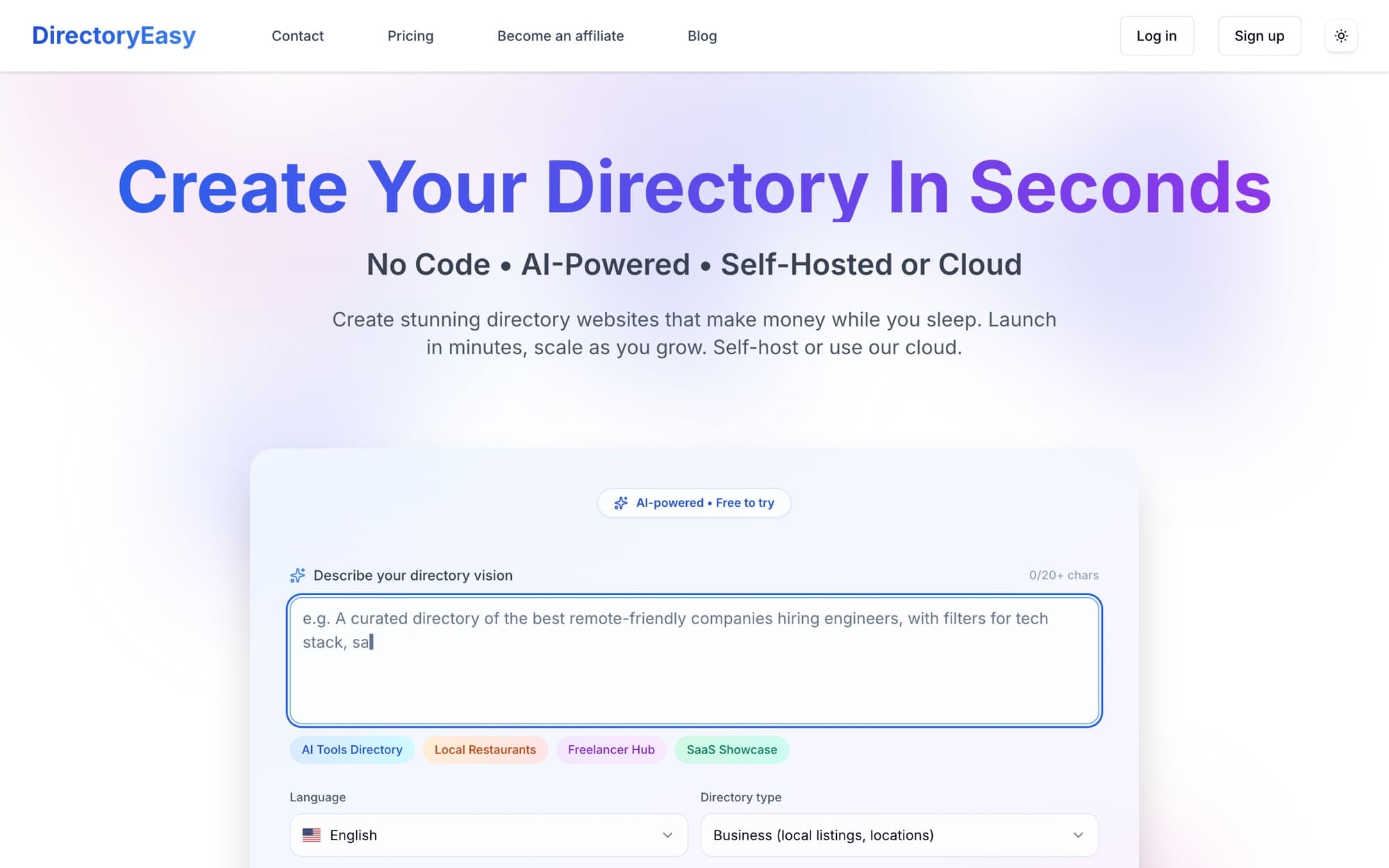
If you would rather skip the plumbing, DirectoryEasy is built for exactly this: you describe the directory you want and it generates the site, with the listing pages, categories, filters, and submission flow already wired up. It runs on their cloud or self-hosted, and there is a free tier to see whether the idea holds up before you commit to it.
The other ways people build them
For completeness, since the right answer depends on how much of a developer you are and whether the directory is a side project or the product itself.
- A spreadsheet plus a front end. Keep the entries in Airtable or Google Sheets and generate the site from it. Softr and Sheet2Site are the names you will run into. The appeal is that editing a row is easier than editing a page, and your data stays portable if you change your mind about the tool.
- A no-code app builder. Bubble and its relatives will do it, with more control over the interface and a considerably steeper learning curve. You are building an application rather than a directory, which is worth it only if you need behaviour a directory tool will not give you.
- WordPress with a directory plugin. Directorist and HivePress are the established ones, and there are directory themes going back a decade. Mature, with paid submissions and memberships already solved. The cost is inheriting WordPress hosting, updates, and security.
- A framework and a starter. Next.js or Astro with a directory boilerplate. Total control, most work, and it only makes sense when the directory is the business rather than a channel for something else. If you go this way, the boilerplate options are in ship faster with a boilerplate.
- A static site and a single data file. Genuinely viable below about fifty entries, and worth remembering before you pay for anything. A markdown file and a template will rank exactly as well, because search engines care about the content rather than what generated it.
Whatever you build it with, the split of effort should be roughly the same: a few days on the site, and then months on the entries. The directories that win are the ones where somebody clearly sat down and formed an opinion about every item on the list.
How directories make money
Worth deciding early, because it changes what you build and how the pages are structured.
Paid and featured listings. The obvious one, and the one that quietly destroys the most directories. The moment placement is for sale, your ranking stops being a recommendation. It works when paid placement is visually obvious and separate from the editorial list, and it fails when the two are blended.
Affiliate revenue. Fits naturally, since you are already sending qualified people to products. Disclose it, and mark those links as sponsored. The trap is letting commission rates decide the order of the list, which readers detect faster than founders expect.
Sponsorship. One sponsor for the whole site rather than per-listing fees. Cleaner than paid placement because it does not touch the rankings, and it needs meaningful traffic before anybody is interested.
Feeding your own product. Usually the best answer for a founder. The directory earns attention from people with a problem you already solve, and nothing about it has to compromise the list. This is why so many indie directories are run by people who sell something adjacent.
The common thread is that every model except the last one creates some tension between the money and the recommendation. That tension is manageable, but only if you decide in advance which side wins.
Turning the traffic into something you own
A directory that ranks sends you visitors who have a specific problem and no relationship with you. If the only thing on the page is an outbound link, that visit is worth nothing the moment they click it.
The fix is small: put one email capture on the directory that is worth subscribing to, usually a short note when the list changes. New entries, price changes, tools that shut down. It is genuinely useful, it costs you one email a month, and it converts anonymous search traffic into a list you can talk to. That list is also the audience you launch your actual product to later, which is the reason a lot of founders build directories in the first place.
If you have never set one up, the mechanics are in how to build a waitlist for your app, and the question of which channel is sending the signups is in which channel brought your signups.
Frequently asked questions
How many listings before it is worth publishing?
Enough that the list is genuinely useful for the niche you chose, which is usually somewhere between twenty and fifty rather than hundreds. Publishing a thin directory and filling it later is worse than waiting, because the first crawl sets an impression.
How long before a directory ranks?
Months, like any other content. The advantage is not speed, it is that the work compounds: each entry you add is another page, and the links arrive on their own once the list is worth citing.
Should the entries link out with nofollow?
If you are linking normally to tools you genuinely recommend, ordinary links are fine. Mark links as sponsored when someone paid for the placement. That is the rule that keeps a paid directory on the right side of the line.
Can a directory make money on its own?
Some do, through featured listings, sponsorship, or affiliate revenue. Most make more sense as an audience-building asset for something else you sell. Decide which one you are doing before you start, because it changes what you build.
Do I need to build the site before gathering entries?
No, and it is usually the wrong order. Put the first thirty entries in a spreadsheet and see whether assembling them is interesting or unbearable. If it is unbearable at thirty, it will be worse at two hundred, and you will have learned that before paying for anything.
What if the products on my list ask to be removed?
Remove them, promptly and without argument. It happens rarely, and the goodwill is worth more than one entry. What you should not do is remove a critical assessment because the company complained, since the honest assessments are the entire reason anyone trusts the list.
Is this just SEO spam with extra steps?
It is if the pages are empty. A directory that collects information people cannot easily get elsewhere is a genuine resource and has been a legitimate format for as long as the web has existed. The format is not the problem; the thin version of it is.
Getting listed on directories is worth one afternoon. Running one is worth considering seriously, because it is one of the few things a solo founder can build where the work accumulates instead of evaporating. Pick a niche narrow enough to own, put real judgement on every entry, and capture an email address while the visitor is still on your page.
Lighthouse handles the email capture side: a signup page, a survey question, and a newsletter you can send from the same place. From an indie dev, for indie devs and makers.