How to Launch a Product Faster: Boilerplates Compared (2026)
Most of the first month goes on auth, payments, and email, not your actual idea. A look at the boilerplates that skip it: ShipFast, MakerKit, supastarter, Spaceport for iOS, and the free options.
Posted by
 Rouzbeh
Related reading
Giving a Support Chatbot Tools, Not Just Documents
A bot that answers from your docs is a weekend. A bot that can read and change a customer's own account is a different problem, and almost none of it is the AI part.
Answering Support When You Are the Whole Company
Support is the highest-quality research channel a small product has, and the fastest way to burn out if you treat it as an obligation. How to answer, what to automate, and how to say no.
The Pricing Page: What to Put On It, and What to Leave Off
Picking the number is one problem, presenting it is another. Plan names, the free tier decision, trials and card-up-front, annual billing, and the things founders add that quietly cost them customers.
Think back to the last product you started. How much of the first month went on the actual idea, and how much went on sign-in, password resets, Stripe webhooks, transactional email, a settings page, and getting the deploy green?
For most indie launches the honest split is something like 80/20, in the wrong direction. Worse, none of that work is differentiated. Your auth flow is identical to everyone else's. You are rebuilding, from scratch, the exact thing every other founder is also rebuilding from scratch this week.
That is the entire argument for a boilerplate. This post covers what they do, the main options in 2026, how to pick one, and the thing none of them fix.
The shortlist
If you only want the links, here they are. Each is covered in more detail below.
- ShipFast. Next.js, best known, built for a solo founder shipping a single-tenant B2C app.
- MakerKit. Next.js and Supabase, with team accounts, roles, and per-team billing already built.
- supastarter. multi-tenant SaaS without being tied to one framework or database.
- Spaceport. the native iOS equivalent: SwiftUI, RevenueCat subscriptions, Apple and Google sign-in.
- nextjs/saas-starter and Open SaaS. free and open source, good for learning or a zero budget.
Table of contents
What a boilerplate actually is
A starter codebase with the undifferentiated parts already wired together. You clone it, change the name, add your keys, and start building the thing that is actually yours.
Nearly all of them ship the same core: authentication, payments, a database layer, transactional email, a landing page, and a deploy config. The differences are in framework, in whether they assume teams, and in how much opinion they impose on your code.
One caveat before the list. Prices move constantly, and most of these run discounts, tiers, and lifetime deals. The figures below are what the sites showed when this was written, so treat them as a rough band and check before you buy.
ShipFast: the best-known one
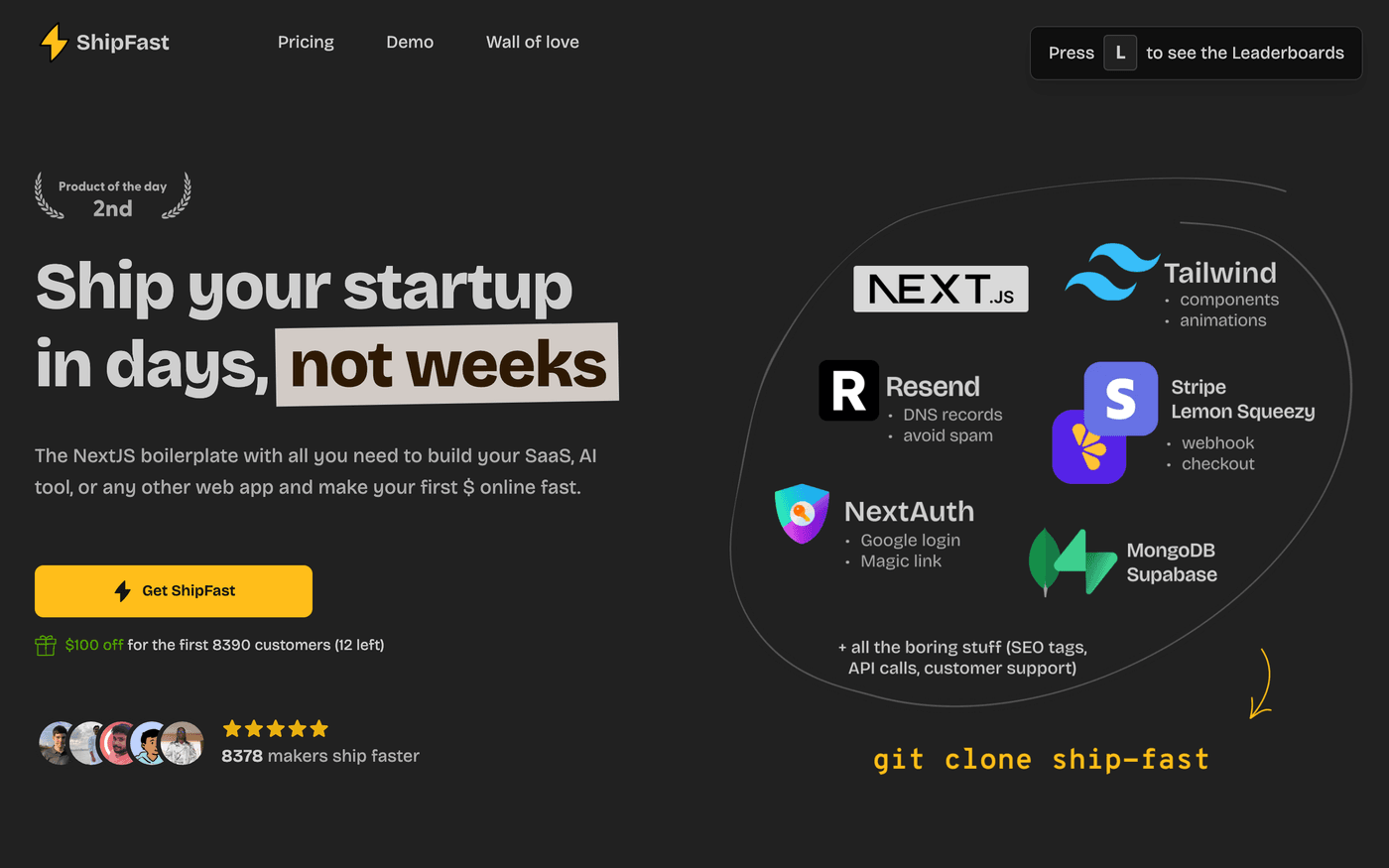
ShipFast is the Next.js boilerplate most indie founders have heard of, and the one that made the category popular. Next.js, Tailwind, Stripe or Lemon Squeezy, NextAuth, Mongo or Supabase, Resend for email, SEO tags, and the rest of the boring stuff.
Its strength is velocity for a solo founder shipping a single-tenant B2C app. Its limits are the flip side: no multi-tenancy, no roles and permissions, no admin panel. If you are building something one person signs up for and uses alone, that is not a limitation. If you are building something teams log into, you will be adding those yourself.
Lighthouse itself runs on ShipFast, so this is not a theoretical recommendation.
MakerKit: for team-based B2B
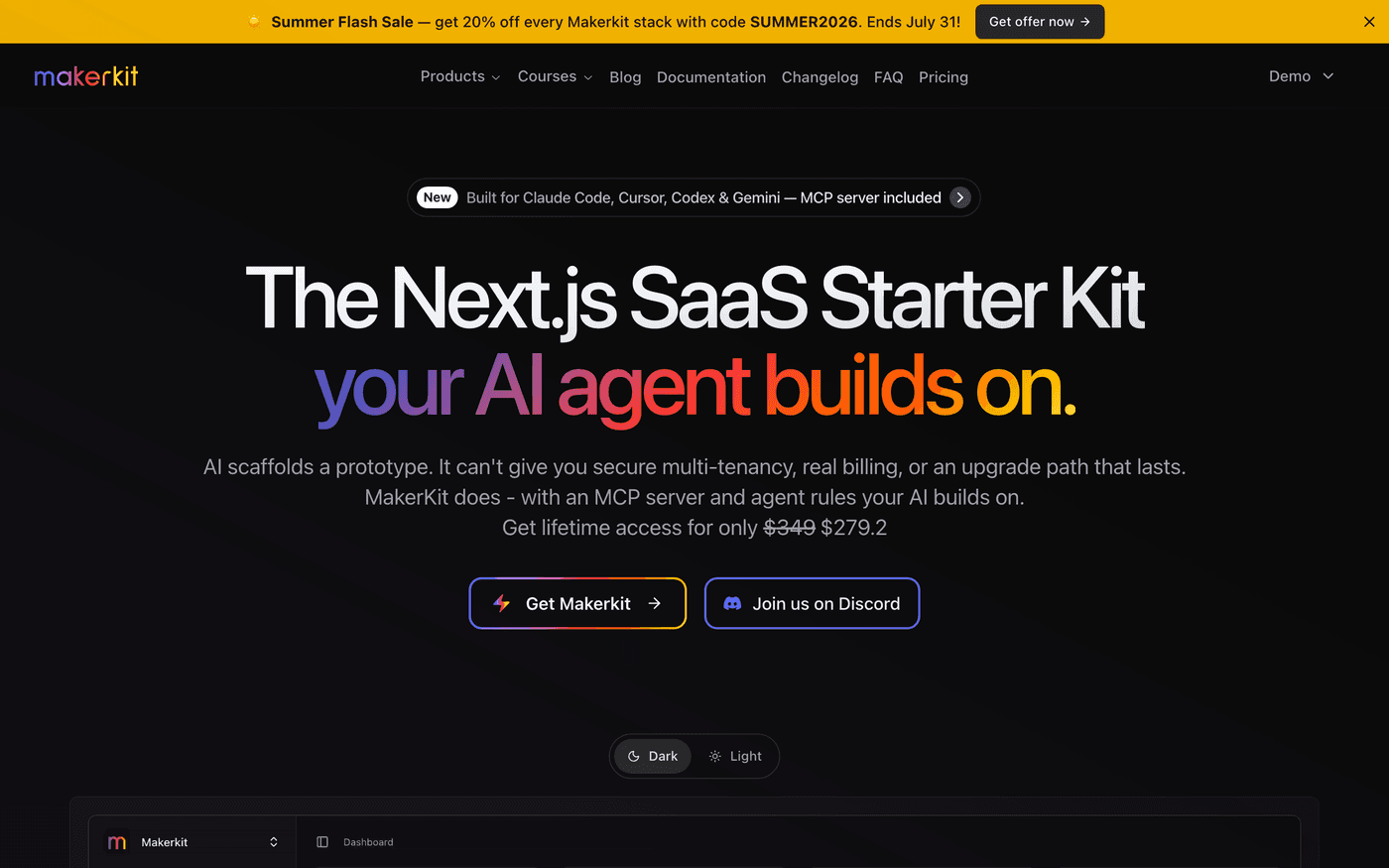
MakerKit starts where ShipFast stops. Team accounts, roles and permissions, per-team billing, an admin panel, and a Supabase-first setup with row level security already thought through.
That extra structure is worth real money if you need it and pure friction if you do not. Multi-tenancy is genuinely unpleasant to retrofit, so if you already know your product is something a team of five logs into, starting here saves weeks. If you are not sure yet, it is a lot of scaffolding to carry.
supastarter: framework choice
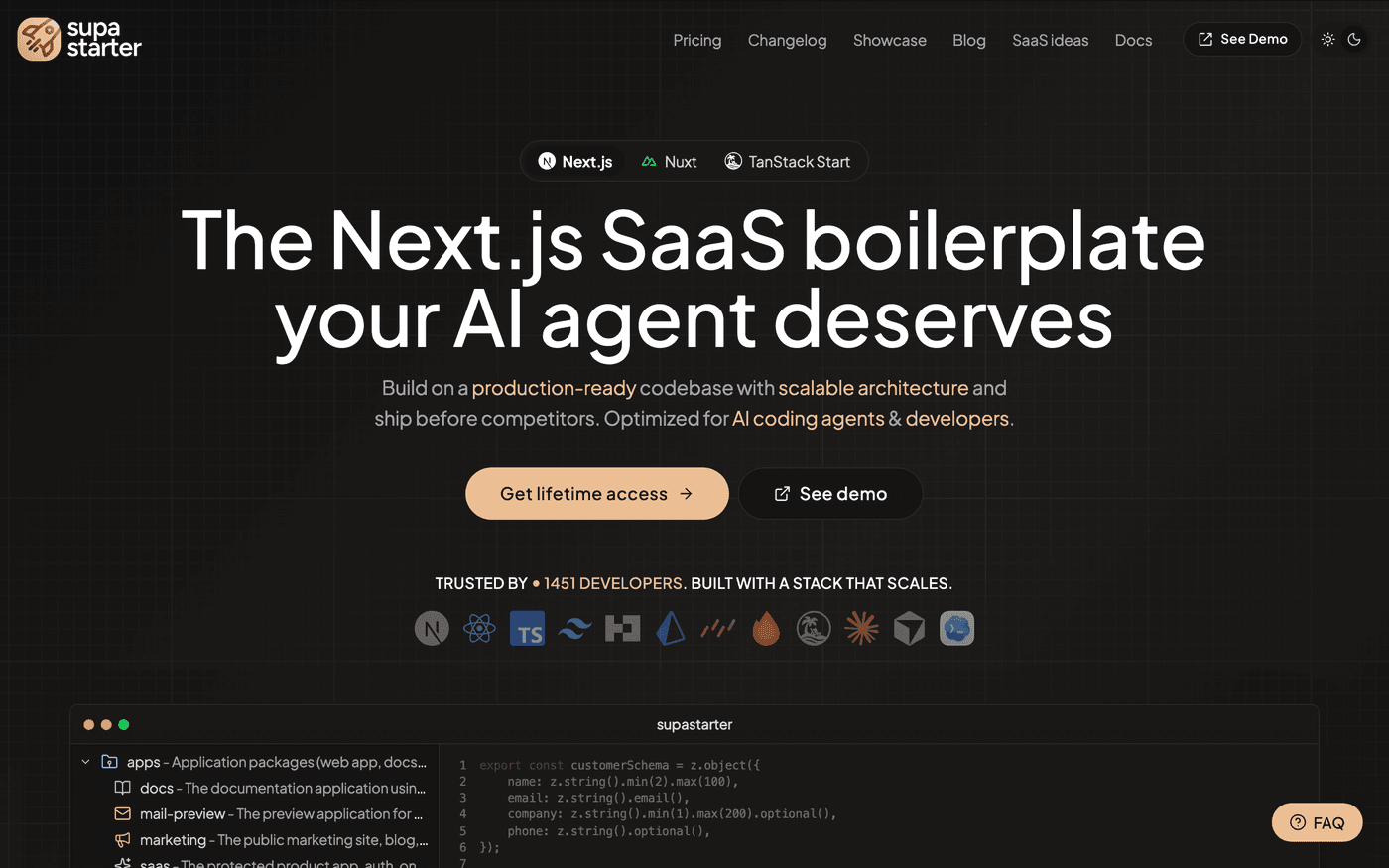
supastarter also targets multi-tenant SaaS, but its distinguishing feature is breadth: it is not tied to a single framework or a single database, so it is the obvious pick if you would rather not write Next.js.
The tradeoff with any multi-framework kit is that abstraction has a cost. Code that has to work across several stacks is usually less idiomatic in each one than code written for a single target. Worth it for the flexibility, not free.
Spaceport: for native iOS
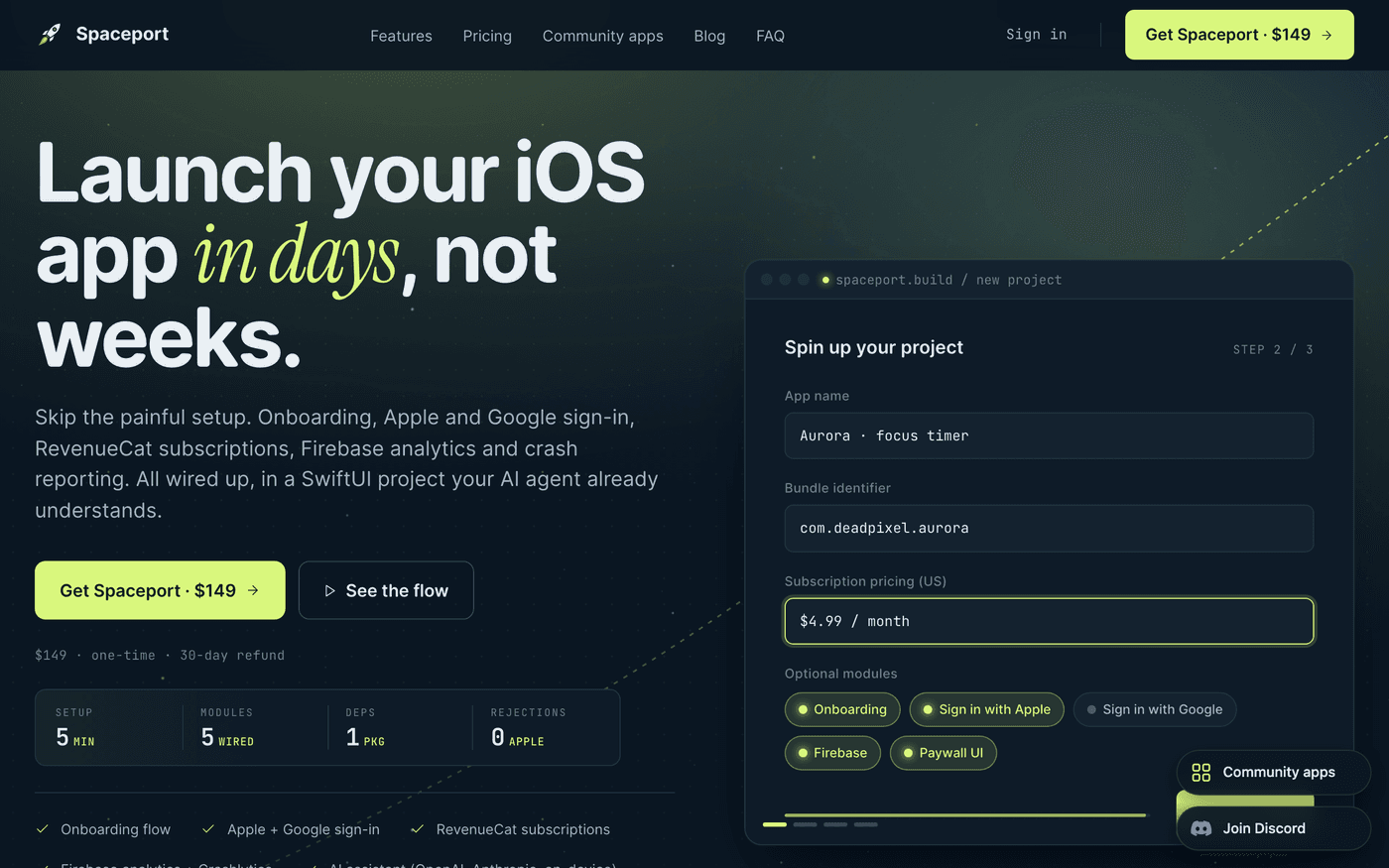
Everything above is for the web. Spaceport is the equivalent for native iOS: a SwiftUI project with onboarding, Apple and Google sign-in, RevenueCat subscriptions, Firebase analytics, and crash reporting already wired together.
The iOS-specific pain it removes is worth naming, because it is not the same as the web's. Wiring RevenueCat to real App Store products, building a paywall that App Review will not reject, and getting the subscription restore flow right are each a day you will not get back. The listed price is $149 one-time with a 30-day refund.
The free options
If the budget is zero, or you want to read the code before trusting the category, the open-source kits are genuinely good starting points. nextjs/saas-starter is the cleanest reference implementation, and Open SaaS is a fuller open alternative.
What you trade is polish and support. Paid kits mostly earn their money on the last 10 percent: the edge cases in billing, the email deliverability details, and someone to ask when a webhook misbehaves at 1am. If your time is worth more than the price, buy. If you are learning, or the product may never charge anyone, clone the free one.
How to choose in five minutes
Answer two questions and the choice mostly makes itself.
| What you are building | Start with |
|---|---|
| Web app, one user per account | ShipFast |
| Web app, teams log in together | MakerKit |
| Web app, not Next.js | supastarter |
| Native iOS app | Spaceport |
| No budget, or learning | nextjs/saas-starter |
One piece of advice that matters more than the choice: pick in an afternoon and move on. Spending two weeks comparing boilerplates defeats the entire point of buying one. They are all fine. The difference between the best pick and the second-best is a rounding error next to the time you would burn deciding.
What a boilerplate does not fix
Here is the uncomfortable part. A boilerplate makes you faster at building. It does nothing about whether you should be building this at all.
The failure mode it enables is real: you save three weeks on setup, spend them building more product instead, and launch six weeks of work to an audience of nobody. Shipping faster in the wrong direction just gets you further from the road.
The cheap insurance is to spend one of those saved days putting up a waitlist with a survey question on the signup form, and sharing it before you write the feature set. Ten signups with answers will tell you more about what to build than three weeks of building will. If nobody signs up, you just saved yourself the other five weeks.
That is what Lighthouse does, and you can put up a free waitlist in about two minutes, no account needed. Pair it with whichever boilerplate you picked: one gets you building fast, the other makes sure the thing is worth building.
Frequently asked questions
Are boilerplates worth the money?
If you would otherwise spend two to four weeks on auth, billing, and email, then a few hundred dollars against that is straightforward maths. If you have never built those things before, there is a second benefit: you see how someone else solved them properly.
Will my app look like everyone else's?
Only if you keep the default landing page, which plenty of people do. Change the typography, the colours, and the copy on day one. The parts that make an app feel generic are all in the surface layer you were going to replace anyway.
Can I use AI instead of a boilerplate?
You can generate a lot of this now, and the gap has narrowed a great deal. What a maintained boilerplate still gives you is the accumulated edge cases: the webhook retry you did not think to ask for, the email domain setup, the subscription state that only breaks on renewal. Generated code tends to be right on the happy path and thin around the edges.
Which is best for a first-time founder?
ShipFast for web or Spaceport for iOS, on the grounds that the simplest thing that matches your platform is the one you will actually finish. Skip multi-tenancy until a real customer asks for teams.
Do I still need to know how to code?
Yes. A boilerplate removes the setup, not the building. It assumes you can read the stack it ships with and add features to it. If you cannot yet, the free kits are a better place to learn than a paid one.