Launch Directories: Which Ones Are Actually Worth It
I submitted to eight launch directories in a fortnight. What they actually deliver, how to spot a link farm in two minutes, and why the badge on your footer sometimes points at a 404.
Posted by
 Rouzbeh
Related reading
Answering Support When You Are the Whole Company
Support is the highest-quality research channel a small product has, and the fastest way to burn out if you treat it as an obligation. How to answer, what to automate, and how to say no.
The Pricing Page: What to Put On It, and What to Leave Off
Picking the number is one problem, presenting it is another. Plan names, the free tier decision, trials and card-up-front, annual billing, and the things founders add that quietly cost them customers.
Why Users Do Not Come Back: Early Retention When You Have Twenty of Them
At twenty users churn is not a metric, it is twenty stories you can read individually. The most common cause is not a missing feature, it is that the problem does not happen often enough to build a habit around.
Over the last two weeks I submitted Lighthouse to eight launch directories, added their badges to the footer, and paid attention to what actually happened. This is what I found, including the parts that were a waste of time.
Short version: directories are worth doing, they are worth doing badly rather than not at all, and almost nobody should spend money on them.

Table of contents
What a listing actually gets you
Three things, in descending order of how much they matter.
A backlink. This is the real product. A dofollow link from a site with some authority is the thing you are actually collecting, and it compounds quietly over months. It is also the thing you cannot see working, which is why people give up on directories too early.
A trickle of traffic. Emphasis on trickle. Unless the directory is one of the two or three everyone reads, expect single-digit visitors, mostly on launch day, mostly other founders. Treat any traffic as a bonus and you will not be disappointed.
A citable mention. This one is newer and underrated. AI engines building an answer about “best waitlist tools” lean on third-party pages, not your own marketing. Being listed in a few places your competitors are listed makes you eligible for that answer.
What you do not get is a launch. A directory listing is a deposit into a slow account. If you need users this week, this is the wrong activity.
Spotting a link farm in two minutes
Some “directories” are businesses that sell links wearing a directory costume. They are easy to spot once you know the tells, and worth avoiding: Google discounts links from obvious schemes, so at best you wasted an hour.
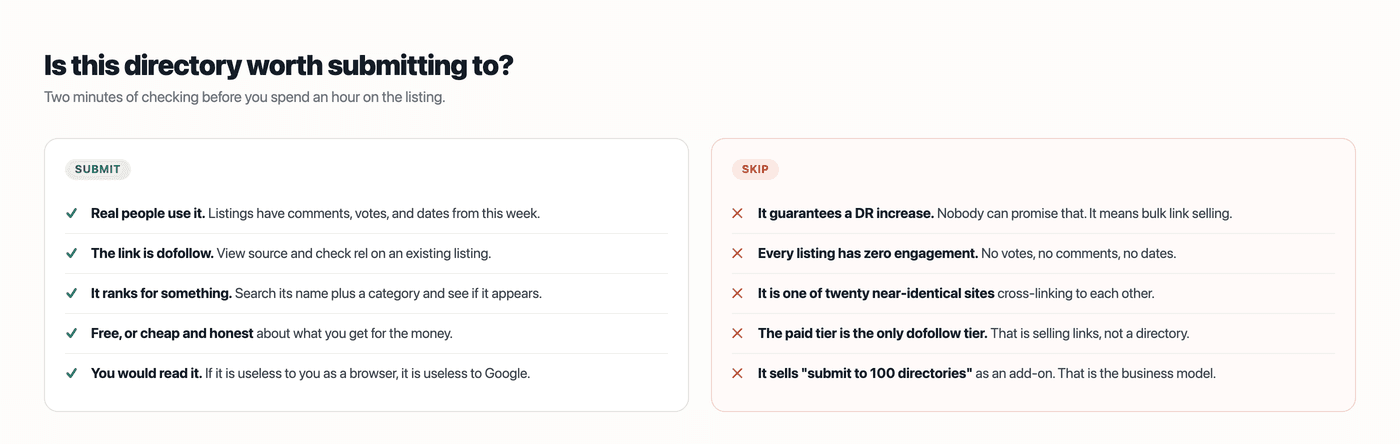
The single loudest signal is a directory that guarantees a domain rating increase. No legitimate site can promise that, because it depends entirely on links they do not control. When you see “guaranteed DR 0 to 15+” as a paid add-on, you are looking at bulk link selling, and the free listing on the same site is the loss leader.
The second is engagement. Open the front page and look at the most recent listings. If every product has zero votes and zero comments, no human reads it, which means no traffic and a link Google has probably already discounted.
The third is the network pattern. If the footer badges point at ten near-identical sibling sites with the same design and a shared naming convention, they are inflating each other's authority rather than earning it.
The order I would do them in
If I started again, I would spend the first afternoon on these and not think about directories again for a month.
- The two big review platforms. G2 and Capterra profiles are free and carry far more weight than any launch directory, particularly for AI answers about your category. This is the highest-value hour on the list and almost every indie founder skips it.
- The alternative-to sites. Listing yourself as an alternative to the incumbents in your category puts you in front of people with buying intent, and feeds every “X alternatives” answer an AI engine assembles.
- Product Hunt, once, properly. Worth real preparation rather than a casual submission, because you only get one first launch.
- The indie launch directories. The long tail I have been working through. Individually small, collectively a reasonable link profile. Do a few a week rather than a marathon.
Notice that the free, high-authority options sit at the top and the ones that ask for money sit off the list entirely. That is not an accident.
The badge trap nobody warns you about
Most directories give you a badge snippet to paste into your footer. Reciprocal linking is the deal: you link to them, they link to you.
Here is the part I only found because I checked. Of the badges I added, two pointed at a 404 on the day I installed them. The badge image loaded fine, so visually everything looked correct. The link just went nowhere. Both resolved a day or two later, once the listing was actually approved, but for that window my footer was sending visitors and crawlers to a dead page.
So: paste the badge, then open the link. If it 404s, either wait for approval before shipping it or take the badge back out until it resolves. A footer full of broken links is worse than a footer with three working ones.
While you are in there, check the rel attribute on the snippet they hand you. Some include nofollow, which is fine for a verification badge but means you are giving a dofollow link and getting nothing back. Know which deal you are agreeing to.
When paying is worth it
Most directories now sell a skip-the-queue tier, usually somewhere between five and twenty dollars. The honest answer on those: the amounts are small enough that it barely matters, and the benefit is small enough that it barely matters either. If a listing genuinely gets you in front of an audience sooner and the fee is the price of a coffee, fine.
What I would not buy is anything in the hundred-plus bracket: the bulk submission services, the paid review articles, the guaranteed-authority packages. Those are the products with the link-scheme risk attached, and the same money spent on one genuinely good piece of writing will outperform them over a year.
The uncomfortable truth is that directories are a supporting activity. They are cheap, they are quick, and they help a little. They are not a growth strategy, and any hour you spend optimising them is an hour not spent on the content and the product that actually compound.
Frequently asked questions
How many directories should I submit to?
Ten to fifteen good ones is plenty. Beyond that the returns fall off sharply and the quality of what is left drops fast. Nobody has ever been saved by directory number forty.
Do I have to put their badge on my site?
Usually not, though some require it for the free tier and check. If the badge is optional and the directory is weak, I would skip it. A footer is finite, and every badge you add makes the others count for less.
Will directory links hurt my SEO?
A handful of legitimate ones, no. Google's stated position is that it discounts links it considers schemes rather than penalising sites for them, so the realistic downside of a bad directory is wasted effort. That changes if you buy a service that blasts you into hundreds at once, which looks exactly like what it is.
How long until I see anything?
Traffic, immediately and barely. Link effects, months. This is why directories are a good task for an afternoon when you are too tired to write code and a bad task to obsess over.
What should I do instead if I only have one hour?
Write something only you could write, then put a waitlist behind it and find out whether anyone wants the thing. Ten signups with survey answers will change your product more than fifty directory listings will.