Fundraising After Launch: What Changes Once You Have Real Numbers
Launching turns a pitch from a story into evidence, and that changes who will talk to you and what they ask. Whether to raise at all, the numbers investors look at first, and where to find the right ones.
Posted by
 Rouzbeh
Related reading
Giving a Support Chatbot Tools, Not Just Documents
A bot that answers from your docs is a weekend. A bot that can read and change a customer's own account is a different problem, and almost none of it is the AI part.
Answering Support When You Are the Whole Company
Support is the highest-quality research channel a small product has, and the fastest way to burn out if you treat it as an obligation. How to answer, what to automate, and how to say no.
The Pricing Page: What to Put On It, and What to Leave Off
Picking the number is one problem, presenting it is another. Plan names, the free tier decision, trials and card-up-front, annual billing, and the things founders add that quietly cost them customers.
Before launch, raising money means selling a story. After launch it means defending evidence, and that is a completely different conversation. You have usage, retention, and a price somebody has actually paid, which means the vague questions stop and the specific ones start. This covers whether to raise at all, what changes now that you have numbers, and where to find investors who fit rather than emailing everyone.
One thing up front: none of this is legal or financial advice, and terms vary enormously by country and by deal. Take anything structural to a lawyer who does this for a living.
Table of contents
Should you raise at all?
For most small software products the honest answer is no, and it is worth sitting with that before reading the rest.
Raising is not a funding event, it is a job. It occupies months of founder attention, which is the only resource a small team cannot buy more of. It also changes what counts as success: money taken at a valuation implies a return at a multiple of that valuation, and a profitable product paying one person well is a failure by that standard while being a complete success by yours.
Raising tends to make sense when something specific is time-sensitive and capital solves it: a market closing, a competitor with a head start, an opportunity that expires. It tends not to make sense as a substitute for revenue, or because progress feels slow. Slow is the normal speed of a product that has not found its channel yet, and money does not fix a channel problem. If your signups have stalled, the diagnosis in why nobody is joining your waitlist is a cheaper place to start.
What launching actually changed
Three things, and they all work in your favour.
- You are being priced on evidence, not on narrative. A pre-launch round is priced on the team and the story. After launch there is data, and while that removes some upside from a great story, it removes far more downside from being an unknown founder without a network.
- The questions get concrete. Instead of "how big could this be", you get asked what happened to the cohort from three months ago. That is a question you can answer with a query rather than a claim.
- You have leverage you did not have before. A product with paying customers can walk away from a bad term sheet, because the alternative is continuing to run a business rather than shutting down.
The flip side is that weak numbers are now visible. Before launch, no data is neutral. After launch, bad retention is a fact in the room. If your numbers are not ready, waiting a quarter and fixing them is almost always better than raising into them.
The numbers they ask for first
At small scale the list is shorter than founders expect, and the order matters.
| What they ask | What they are really checking |
|---|---|
| Retention by cohort | Whether the product is used or just bought. This is the first thing looked at and the hardest to dress up. |
| Growth rate, not total | Small and compounding beats large and flat. The absolute number matters much less than the shape. |
| Where customers come from | Whether you have a repeatable channel or a lucky launch spike. Have the answer from which channel brought your signups. |
| Revenue concentration | Whether one customer is most of the revenue, which is risk rather than traction. |
| Your own burn and runway | Whether you understand your business. Not knowing this number is worse than the number being bad. |
At the volumes an indie product has just after launch, retention is the one that carries the conversation. Thirty users who keep coming back tells a better story than a thousand signups who did not, because the first can be multiplied by marketing and the second cannot be fixed by it.
The options, cheapest first
Equity is the most expensive money available, and it is the one everyone reaches for first. Roughly in order of what they cost you:
- Customers. Annual plans paid up front, or a discounted lifetime deal to a small group, are financing without dilution. Raising your price is the same thing and even cheaper. There is more on that in how to price your first indie SaaS.
- Grants. Slow, paperwork-heavy, and free in dilution terms. Most countries have innovation or small-business schemes that founders never look at because the forms are dull.
- Revenue-based financing. You repay from a share of revenue rather than giving up equity. It suits a product with predictable subscriptions and it is genuinely expensive if growth stalls, so read the effective rate rather than the headline.
- Angels. Individuals writing smaller cheques, often faster and with lighter terms than a fund. The good ones bring introductions in your specific market, which is usually worth more than the money at this size.
- Accelerators. Money plus a deadline plus a network, in exchange for a chunk of equity and three months of your attention. Best judged on whether their alumni are in your market rather than on the brand.
- Pre-seed and seed funds. The largest cheques and the largest commitment, both to the dilution and to the growth expectations that come with it.
- Equity crowdfunding. Works when you have an audience already, because you are effectively marketing to your own users. It is a public campaign with real compliance overhead, not a shortcut.
Most founders who end up raising do it from the middle of this list, and most who skip the top two later wish they had not.
Finding investors who actually fit
The thing that wastes the most time in a first raise is not rejection, it is talking to people who were never going to invest. Funds have mandates, and most of them are invisible from the outside: a stage they write at, a geography they are allowed to fund, a sector focus, a minimum revenue, sometimes a rule about solo founders. A polite no after three meetings usually means you failed a filter that was set before you emailed.
So the first job is a filtered list, not a big one. Twenty investors who match your stage, sector, and cheque size will outperform two hundred names scraped from a spreadsheet, and it is a far less demoralising month.
A few places founders build that list. Crunchbase and similar databases are useful for seeing who has funded companies like yours recently, which is a better signal than a fund's own website. AngelList is where a lot of angel activity happens. OpenVC collects funds that accept inbound approaches, which matters when you have no warm introduction. And the most underrated source is the funding announcements of products adjacent to yours, since the investor who just backed a similar company already understands the market.
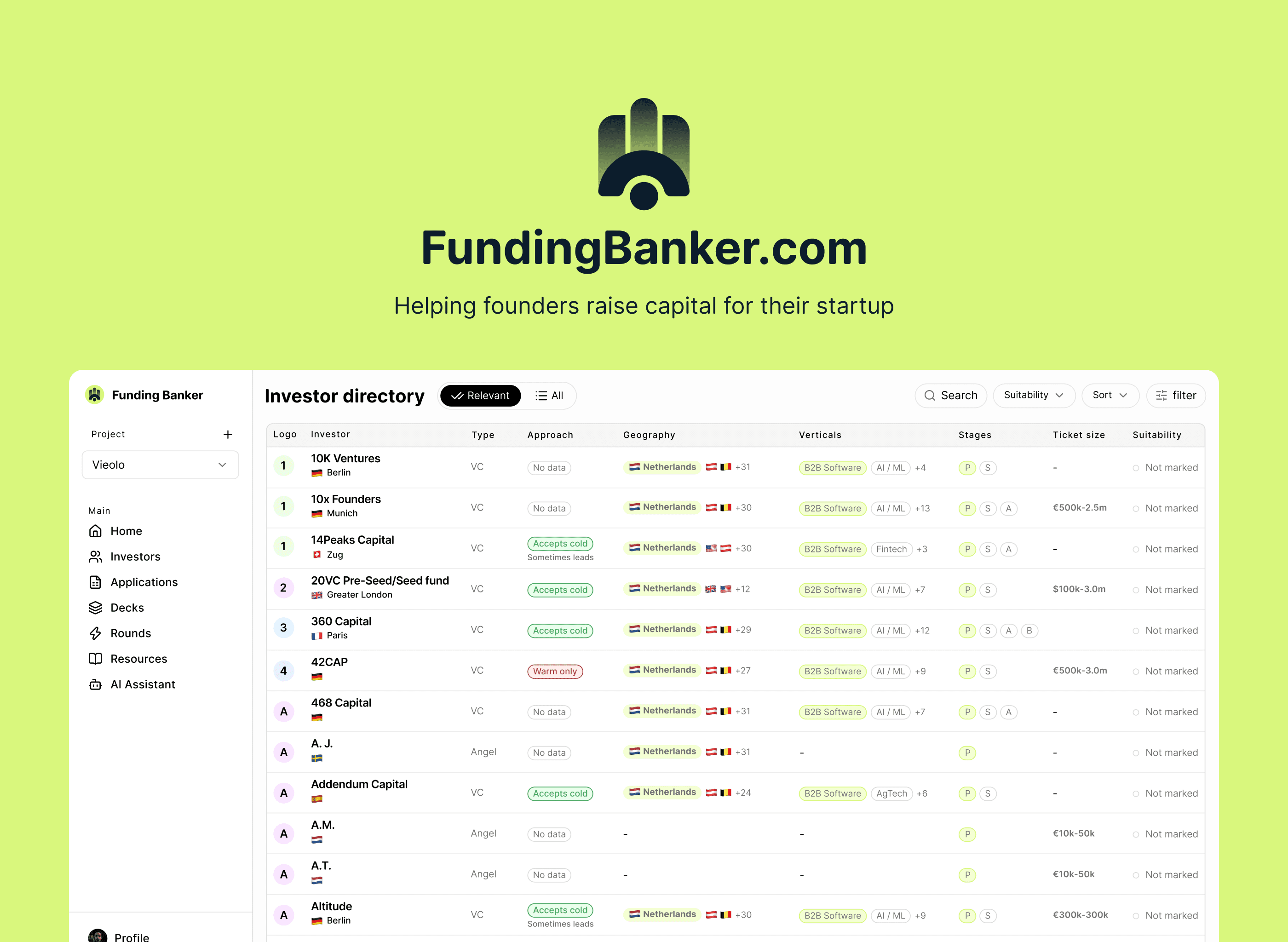
Funding Banker
If you would rather not assemble that yourself, Funding Banker is built specifically around this problem: an investor directory you can filter by stage, geography, sector, and cheque band, including the quiet gates like minimum revenue and founder count that disqualify most rounds before a conversation starts, plus the round management and investor updates that follow. It also exposes an MCP endpoint, so you can query the directory from Claude or another AI assistant rather than clicking through filters, which will feel familiar if you have read what MCP is in plain English.
Start the investor update before you need it
The highest-return habit in fundraising costs about twenty minutes a month and most founders start it too late. Write a short monthly update and send it to everyone who has expressed interest, including the ones who said no.
Five lines is enough: the key number, what you shipped, what you learned, what is hard, and what you need. Send it whether the month went well or badly, because the point is not the content of any one update. It is that six of them in a row demonstrate a rate of progress, which is the single thing an investor is trying to estimate and the one thing a pitch deck cannot show.
A meaningful share of investments come from someone who said no earlier and watched for six months. That only works if they were receiving something.
Frequently asked questions
How much revenue do I need before anyone will talk to me?
There is no threshold that applies everywhere, and any specific number you read is someone generalising from their own market. What travels better is the shape: consistent month-on-month growth from a channel you can describe, with users who stay.
Do I need a warm introduction?
It helps enormously and it is not mandatory. Cold outreach works when it is short, specific, and obviously targeted at that investor's stated focus. Some funds explicitly accept inbound, which is worth filtering for.
Should I build a deck or just show the product?
Both, and the deck is mostly for forwarding. Ten slides that survive being read without you in the room is the format, because the person you met will show it to partners who never meet you.
Is it a bad sign if I get rejected a lot?
No, that is the base rate, and it is the main reason to filter the list before you start. What matters is whether the reasons repeat. The same objection from five investors is product feedback wearing a suit.
Can I raise and stay small?
Not from a fund whose model requires large outcomes, and yes from angels or revenue-based financing whose returns work at smaller scale. The mismatch to avoid is taking money on terms that assume growth you do not intend to chase.
Launching moved you from asking people to believe a story to asking them to read a number, which is a much better position even when the number is small. Decide honestly whether you need the money at all, exhaust the cheaper options first, then talk to twenty investors who fit rather than two hundred who do not. And start sending the monthly update now, because the round you raise next year will mostly come from people already on that list.
Lighthouse handles the waitlist, survey, newsletter, and feedback side of a launch, so the retention and channel numbers you will be asked about are somewhere you can actually find them. From an indie dev, for indie devs and makers.